thebackcut.com
Creative under test: Own Meta creative: “The '$500 Guy' Vanished”. First of three on the panel: 79%, vs 73% legacy frame and 69% competitor-envy.
PANEL
2026-07-13
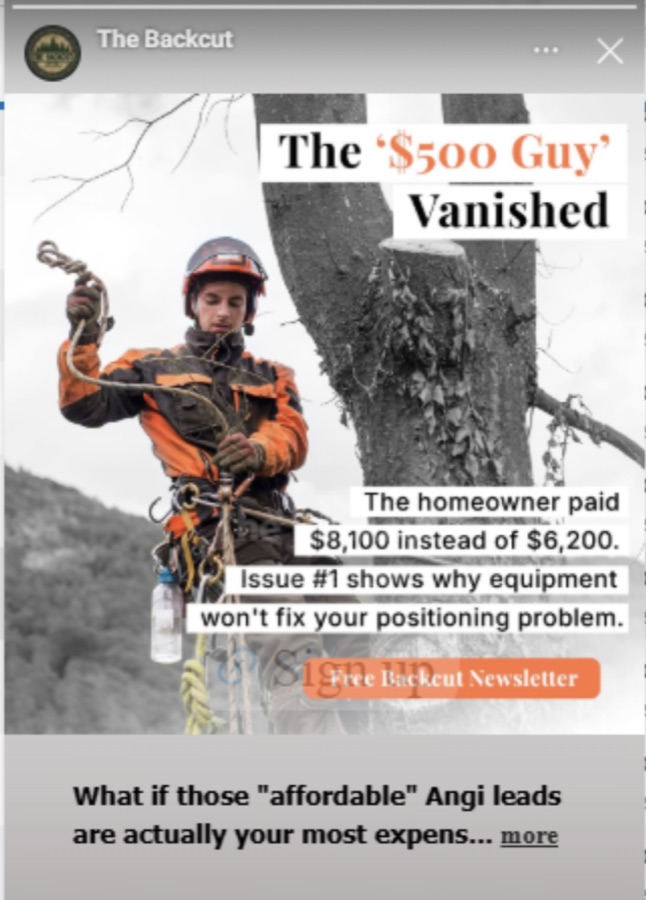
The creative, as served on Instagram (screenshot from the live placement).
The '$500 Guy' Vanished
Black-and-white photo of a young arborist roped high in a tree, orange safety gear, editorial text overlays. Overlay: “The homeowner paid $8,100 instead of $6,200. Issue #1 shows why equipment won't fix your positioning problem.” Primary text: “What if those 'affordable' Angi leads are actually your most expensive...” Tested against two sibling creatives on the same panel: the two-generation legacy-frame ad (“A Legacy of Heights”) scored 73% and the competitor-envy ad (“Your competitor books $5K jobs...”) scored 69%; this ad also won a separate head-to-head comparison run.
CTA: Free Backcut Newsletter (Sign up)
Weighted across all six archetypes, scored 1 to 5 per dimension. The shape is the diagnosis: where the polygon collapses is where the creative loses this audience.
“That headline stopped my thumb. The $8,100 vs $6,200 spread is realistic enough that it doesn't feel like made-up marketing nonsense. But the second it turns into a pitch for some overpriced service package, I'm out.”
Blocker: Assumes free content is a funnel to a $500/mo retainer; the first sales pitch is his unsubscribe trigger.
Driver: The ad reads like it was written by someone who knows trees: positioning, Angi leads, shared leads going to six other guys.
“I've literally lost jobs to some dude with a pickup and a Stihl who disappears mid-project. The $8,100 vs $6,200 detail feels real, and positioning instead of 'run better ads' tells me whoever wrote this understands tree work pricing.”
Blocker: Gives Issue #1 five minutes to be as specific as the ad implies; unfollows fast on fluff.
Driver: Zero risk (free, not a $2K course) plus a hook that mirrors a recurring personal loss.
“I know exactly what 'the $500 guy vanished' means because we've lost jobs to those guys and then watched them disappear on the homeowner. If the free content is actually tactical, I'll forward it to my husband.”
Blocker: Suspects a $2,000 coaching pitch two emails in; will audit a few issues before trusting it.
Driver: Real dollar amounts signal real numbers, not fluff; email she can ignore beats a subscription she must cancel.
“That headline is basically the story of my career: I've watched dozens of lowballers come and go. But I've never signed up for anything off Facebook. Cold off my feed, I'm probably scrolling past even though the message resonates.”
Blocker: Distrusts the delivery mechanism itself; would need the newsletter shared by someone he knows.
Driver: The message validates thirty years of not racing to the bottom; emotional resonance is the one dimension where he scores high.
“The line about positioning over equipment hits exactly where I'm at trying to move upmarket for municipal work. I've done the math on Angi leads; the real cost-per-close is ugly. The ad earned the click.”
Blocker: The bar is 'does this give me something Arbor Age or TCIA doesn't'; thin content loses him fast.
Driver: Pricing specificity signals content written for operators actually running numbers.
“The '$500 Guy' thing hits because I AM that cheaper guy right now. Seeing someone frame that as a losing position makes me uncomfortable in a way that means it's probably true. I need to see that math.”
Blocker: Only converting because it's free; will unsubscribe in two weeks if it's fluff and upsells.
Driver: The ad calls out his own strategy as the losing position: productive discomfort plus zero cost.
Sharpest blocker: Funnel suspicion: five of six archetypes volunteered some version of 'the second this turns into a $2,000 coaching pitch, I'm out'.
Strongest driver: The specific dollar spread ($8,100 vs $6,200): read as real operator math, not marketing, by every archetype.
The loss-story angle wins the three-way test (79% weighted, vs 73% for the legacy frame and 69% for the competitor-envy ad, which were close enough to swap order between test methods). It converts every archetype except Ray, whose profile never signs up from cold social; reach spent against him is waste, not upside. The universal blocker is funnel suspicion: early issues must stay visibly free of upsells, because the panel names the first pitch email as the unsubscribe trigger. The legacy frame reads beautifully but converts identity, not action; if it runs at all, run it against warm retargeting audiences rather than cold acquisition.
This is the modeled layer end to end: synthetic archetypes (seeded from the passport's verified composition) reacting to sample creative. Scores are simulated receptivity, not predicted campaign performance, and are never quotable as measurement. The verified layer lives in the passport this report accompanies. A real sponsor engagement runs the sponsor's actual creative through this same instrument before placement.
Issued by audiencepassport.com · 2026-07-13 · pre-flight format v0.1 (sample) · passport format v0.3 draft